

Origins, Mission & Vision
Launched in 2021, the Black Butterfly Urban Farmer Academy (BBUFA) began as a pilot training program, made possible through funding from the Northeast Sustainable Agriculture Research and Education program. During the 2021 and 2022 growing seasons, we trained two cohorts of farmers in sustainable agriculture methods and farm business planning through classroom sessions, on-farm work, and field days. This pilot program was designed to provide micro-scaled urban farm training to people who live and/or work in the “butterfly wings” of Baltimore City—especially those who are socially disadvantaged (see USDA 2501 definition.) Members of these first two cohorts are now making their mark on the food system, and their success continues to motivate us as we grow and strengthen the pipeline for future farmers.
Today, BBUFA is the home of multiple educational programs with the mission to create a pathway for people to deepen their knowledge and training in small-scale, urban agriculture and become part of the next generation of urban farmers in Baltimore City. Graduates will help achieve our vision of an agri-food system where urban farms are creating more opportunities for local economic development, social connection, and food sovereignty for all Baltimore communities.
BBUFA On-Farm Fellowship
Applications are OPEN NOW and due by December 1st!
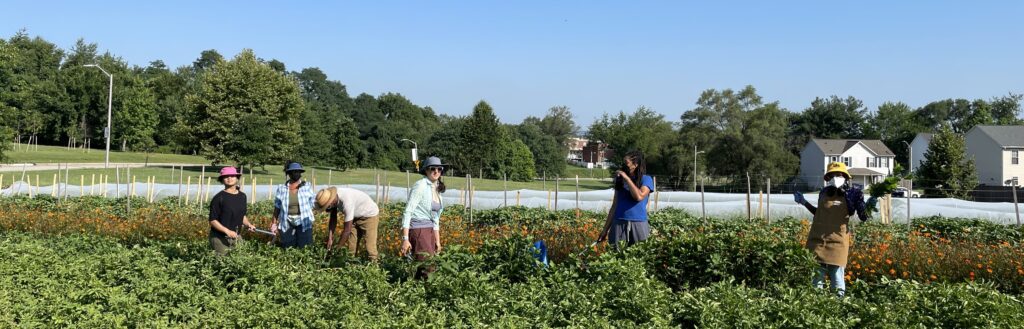
Beginning with the 2027 season, BBUFA’s On-Farm Fellowship will provide an exciting opportunity for a cohort of beginning farmers to deepen their knowledge of small-scale agricultural methods as part of the next generation of urban farmers in Baltimore City. It is designed to teach production at a community level, equipping program fellows with concrete technical skills so they can support urban agriculture’s role as a driver of economic opportunity, social connection, and food sovereignty in Baltimore communities.
Fellows will dedicate one day a week (24 – 30 hours a month) to the fellowship over the course of an 8-month training program (March through October). They’ll begin with an 8-week classroom series covering the fundamentals of urban agriculture, farm management and planning, and urban agriculture’s history and role in Baltimore’s food system. Then, fellows will participate in 6 months of weekly on-farm work days throughout the peak growing season where they’ll practice the many skills involved in small-scale production farming. They’ll also get the opportunity to engage with various member farms of the Farm Alliance of Baltimore to learn about the diverse approaches to urban agriculture being practiced throughout the city.
For the 2027 cohort, FAB is grateful to have received grant funding to compensate fellows in the form of a completion award of $3,750 to incentivize participation and make our program more accessible. Fellows will also be eligible for a seed award of up to $500 by completing and submitting a proposal by the end of their fellowship.
All interested applicants must apply via our online application. The application requires contact and demographic information, an acknowledgement of program requirements, and short-answer questions. You can download the short-answer questions and the scoring rubric to help support you in your drafting of the application.
The application for the 2027 fellowship opens November 3rd, 2026 and closes December 1st, 2026 at 11:59PM. Please reach out to bbufa@farmalliancebaltimore.org before the deadline if you require any technical assistance in filling out the application.
An applicant information session will be held via Zoom on November 12th, 2026 from 12-1PM where anyone interested can hear more about the program and ask questions. Slides from the session will be linked to this page after its completion.
Frequently Asked Questions (FAQs)
What topics will the fellowship cover?
Between the classroom and on-farm work days, we anticipate covering the following topics:
- Crop planting and maintenance: all that goes into caring for crops, including seeding, transplanting, weeding, integrated pest/disease management, nutrient management, and termination.
- Harvesting and handling: post-harvest washing and packing, product distribution networks, food safety
- Site and infrastructure management: site development, field preparation, water/irrigation, use and maintenance of tools and machinery, season extension equipment and techniques, winterization
- Farm planning and management: sales, marketing, business structure, crop planning, land access, funding, recordkeeping, labor
- Soil health and sustainability: cover cropping, mulching, crop rotation, ecological land stewardship
- Community engagement: managing volunteers, neighbor relationships, partnerships, outreach
- Urban agri-food systems: history, culture, and significance of urban agriculture, the food sovereignty movement, and contextualizing our work within Baltimore City’s food system
Are there topics that the fellowship won’t cover?
While we value all kinds of growing and land stewardship, the BBUFA on-farm fellowship is not designed to teach home gardening techniques, homesteading, animal husbandry, hydroponics, or aquaponics.
FAB’s member farms hold a wide variety of educational events that often cover many of these topics, so we encourage interested folks to engage with them by subscribing to our newsletter or visiting our website to learn more!
Who will be teaching the fellowship?
The fellowship program is managed by FAB’s Urban Agriculture Education Manager (Justin), who has an educational background in community health and agri-food systems in addition to experience as an urban farmer/educator. Fellows will also receive regular instruction from FAB’s Farm Manager (Kristin), who brings two decades of farming knowledge that include starting her own farm business and training beginning farmers. Other FAB staff, including our Executive Director (Denzel) and Program Manager (Alison), will contribute their wisdom and expertise as long-time farmers, educators, and advocates in Baltimore City.
FAB’s member farmers and community partners are also expected to participate in this fellowship as guest instructors and workshop hosts, using their sites and expertise to model diverse and community-focused approaches to urban agriculture. Many in our network are graduates of past BBUFA programs and can speak to the experience of working as a beginning farmer in Baltimore City.
Last but not least, we guarantee you’ll learn a lot from the other fellows! The cohort model is designed to promote strong relationships and collaboration between fellows, and each participant will bring in diverse knowledge, perspectives, and life experiences that will contribute to everyone’s learning.
How much time will I need to commit?
We estimate that the fellowship will require 24 – 30 hours per month, equivalent to approximately one full workday per week:
- March–April: One 6-hour day of classroom learning per week at the FAB office, located at 1500 Union Ave in the Hampden neighborhood.
- May–October: One 6-hour workday per week at Black Butterfly Teaching Farm, located at 3901 W. Bay Ave. in the Curtis Bay neighborhood.
Classroom and on-farm workdays will occur on weekdays (likely Wednesdays and/or Thursdays) during regular working hours (likely between 9am-3pm).
Additional Participation Requirements
In addition to weekly classroom and farm days, fellows are expected to complete approximately 34 hours of additional assignments throughout the program:
- 2 shifts at a FAB farmers market stand (8 hours each)
- 2 shifts at the onsite farm stand (4 hours each)
- 5 educational workshops (2 hours each)
Activities for these participation requirements will occur on evenings and weekends and fellows will complete sign-ups in advance.
Throughout August and September, fellows will have the opportunity to independently work on a seed fund proposal to fund a future project or expense in their urban agriculture work. The proposal will be reviewed by the program team, who will provide guidance and feedback before making the awards.
Is the fellowship paid?
Yes! We are excited to support our 2027 fellows with a completion award amount of $3,750 along with the potential for a seed award of up to $500, adding up to $4,250 of total compensation.
The completion award will be paid in two equal installments at the midpoint (July) and the endpoint (November) of the fellowship for each fellow that meets the program requirements at the time of issuance. Fellows will receive information about the seed award at the midpoint of the fellowship and will complete and submit a proposal by the end of the fellowship. The seed award amount will be included along with the second completion award payment issued at the end of the program.
What are the other benefits to completing the fellowship?
One of the most valuable benefits fellows will receive is consistent hands-on education from experienced farmers. Opportunities to ask questions, seek advice, and receive personalized, constructive feedback will give fellows a strong foundation of knowledge they can bring into their future endeavors.
During the fellowship, fellows will be given free attendance at all Field School classes and FAB workshops in addition to those they are required to attend. All fellows who graduate from the fellowship will receive a certificate of completion and two free years of FAB membership.
What are the requirements to graduate from the fellowship?
To successfully graduate from the fellowship and receive the completion award, fellows must:
- Attend at least 80% of scheduled classroom and farm workdays.
- Complete 100% of additional participation requirements.
Do I need prior farming or gardening experience?
While prior experience is not necessary, the most ideal applicants for this fellowship will have some background (1-3 seasons) in farming/gardening. This could include past jobs, internships, regular volunteering, or regular attendance at BBUFA field school or other training programs.
Because of its focus on beginners, this fellowship is less appropriate for people with higher levels of experience. We are in the process of designing future opportunities for more experienced farmers, which we will share soon!
What other characteristics are you looking for in an ideal applicant?
The most ideal applicants will have clear goals for their future involvement in urban farming that involve producing at a scale that can support the wider community rather than a single household or immediate family/friends.
We are looking for people with roots in Baltimore City and/or whose goals involve engagement with Baltimore City communities. An ongoing connection (job, volunteer, etc.) to a Baltimore City urban farm is a plus, as long as your work can accommodate the commitments of this fellowship.
We recognize that certain groups have faced unjust barriers to participation in urban agriculture throughout history and including today. To truly transform Baltimore City’s food system, we believe we can start by making it more participatory. Therefore, we are prioritizing admission of applicants who are part of historically underserved farming communities (as defined by the USDA), which include Black, Indigenous, and other people of color farmers; low-resource farmers; beginning farmers; and/or military veterans.
Are there any virtual options to participate?
We believe urban agriculture education is best when it’s hands-on and done in community. Therefore, this program will be held completely in person and we will not be offering any virtual options to participate.
What’s the difference between the BBUFA On-Farm Fellowship and the BBUFA Field School?
The BBUFA Field School is a hands-on, seasonally guided series designed to introduce participants to the fundamentals of urban agriculture. Running from March through December, the BBUFA Field School offers an accessible entry point for anyone interested in learning how to grow food in the city. No previous farming experience is required.
The Field School might be a better fit if you:
- Are at the very start of your growing journey
- Intend to grow for an individual household
- Primarily want to meet and connect with other growers throughout the city
- Cannot commit to the time required for the fellowship
Can I apply for the fellowship if I have already participated in a BBUFA program?
We encourage members of our community that have attended past FAB events, including the BBUFA Field School, to apply. Attendance at prior events is recorded by FAB staff and will make your application more competitive by demonstrating interest and commitment.
If you were a member of previous cohorts of BBUFA on-farm trainees (2021 & 2022), we are not able to consider your application to the fellowship at this time. We are currently developing future opportunities for more experienced farmers, so stay tuned as we roll those out in future seasons!
Are there age restrictions for participation?
At this time, our fellowship is focused on adult learners; therefore we require all applicants to be age 18 or older.
What are the physical requirements?
Fellows should be prepared to work outside for multiple hours on uneven terrain during all weather conditions. Some farm tasks require repeated or extended standing, squatting, bending over, kneeling, gripping, and/or lifting of items in excess of 20 pounds. We acknowledge this may create physical limitations for some individuals to participate in the fellowship and will provide accessibility accommodations to the best of our ability to hopefully make your participation possible.
Does the fellowship accommodate Spanish speakers or other English-language learners?
We recognize that our work takes place in communities with diverse linguistic and cultural backgrounds. However based on our current capacity, the BBUFA On-Farm Fellowship is conducted primarily in English. We’re aware that this could create challenges for some applicants, and we aim to support non-native English speakers as best as we can while acknowledging potential gaps in our ability to effectively engage those with limited English proficiency.
How are the fellows selected?
A review committee of Farm Alliance of Baltimore staff and members will review applications, score them according to a rubric, and recommend applicants for interviews. Committee members will be asked to recuse themselves from reviewing an applicant with whom they have a close professional or personal relationship.
After the first round of application review, a smaller pool of applicants will be advanced to the interview stage. Interviews will be conducted by a panel of review committee members and will take approximately 30 minutes to complete. Once all interviews have been completed, the review committee will meet and make recommendations for selections. All applicants will be notified of their status at this point (exact date TBD, likely mid January).
Can I use A.I. to help me draft my application?
We understand that A.I. programs can be helpful in writing processes. However, your application is your chance to communicate in your own voice who you are and what you would bring to the fellowship to the review committee. Therefore, the use of A.I. to draft answers that are not your original thoughts or words is not recommended.
Who should I reach out to if I have more questions?
If you have more questions about the fellowship, please reach out to bbufa@farmalliancebaltimore.org and our program team will provide you with the support you need!
BBUFA Field School
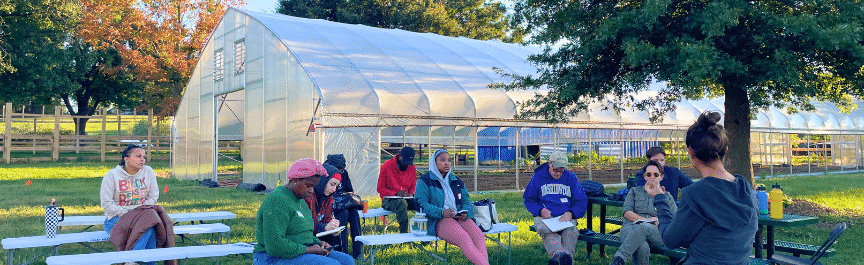
In 2026, we launched the BBUFA Field School–a hands-on, seasonally guided training program designed to introduce participants to the fundamentals of urban agriculture. Running from March through December, the BBUFA Field School offers an accessible entry point for anyone interested in learning how to grow food in the city. No previous farming experience is required.
The program is structured around three seasons—spring, summer, and fall—and focuses on practical, in-the-field learning. Most sessions will take place at the Farm Alliance of Baltimore’s teaching farm in South Baltimore, with occasional classroom-based sessions depending on the topic.
Classes will meet for 2 hours, 2x a month. Registration and more details on our Eventbrite.
Future Programs
We are currently building new and exciting steps in our educational pathway for urban farmers. Beginning with the 2028 season, we hope to debut new programs that allow participants to dig even deeper into urban agriculture as a profession and increase their levels of management and independence.
Check back on this page, subscribe to our newsletter, and follow us on Facebook & Instagram for future updates and announcements.
For additional questions, please contact our Urban Agriculture Education Manager at bbufa@farmalliancebaltimore.org.
Acknowledgements
We are deeply grateful to the staff, board, farmer members, community, and friends whose inspiration, ideas, and partnership have made this dream a reality. And a special thank you to Dr. Lawrence Brown, whose academic scholarship gave us the language of the “Black Butterfly.” We are honored to uplift his work and encourage everyone to read his powerful book, The Black Butterfly: The Harmful Politics of Race and Space in America.